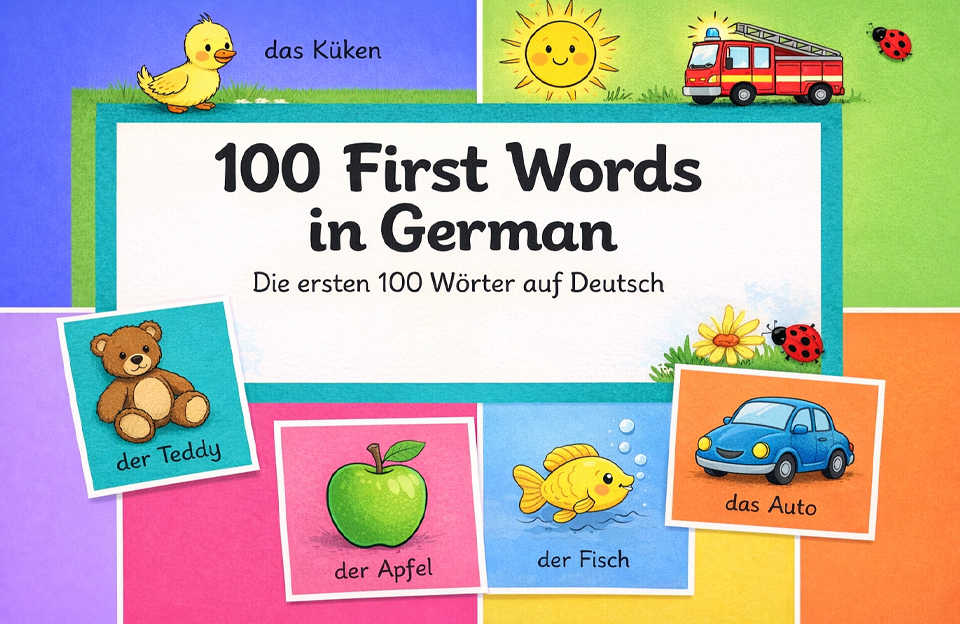
Learning a new language often starts with very basic steps, and for German, vocabulary is the most important foundation for beginners. Without basic vocabulary, learners may struggle with reading, listening, speaking, and progressing to other language skills. This lesson is designed specifically for beginners learning German, with the goal of helping you become familiar with common words in a simple, clear, and approachable way.
Instead of trying to learn too many words in a short time, this lesson focuses on building vocabulary step by step. The words included are basic and commonly used, making them suitable for beginners at the early stages of learning German. This approach helps learners avoid feeling overwhelmed and makes it easier to stay motivated over time.
Each word is presented together with a clear English meaning, allowing learners to understand the content quickly without complicated explanations. Using English as a support language helps beginners feel more comfortable, especially those who are completely new to German. Some words are also accompanied by short example sentences to help learners see how they are used in simple contexts.
For beginners, becoming familiar with German spelling and pronunciation is essential. Regular exposure to basic vocabulary helps learners recognize written words, understand common patterns, and feel more confident when reading German. This lesson is designed to support slow, steady learning, reducing fear of making mistakes and building confidence step by step.
This lesson is suitable for a wide range of learners, including:
- Beginners starting to learn German from scratch
- A1-level learners who want to strengthen their vocabulary foundation
- Learners looking for a simple and easy way to study German vocabulary
- Self-learners studying German at home
Regular vocabulary review is an important part of language learning. This lesson encourages learners to study a manageable number of words and review them consistently over time. Learning a small amount regularly is far more effective than memorizing large lists in a short period. With continuous review, vocabulary gradually becomes more familiar and easier to recall.
Building vocabulary in a structured way also helps learners feel more confident when moving on to other skills. Once basic words are familiar, learning grammar, reading short texts, and forming simple sentences becomes much easier. Vocabulary serves as the foundation that supports long-term progress in learning German.
This lesson does not require any prior knowledge of German. The content is presented in a beginner-friendly format, allowing learners to study at their own pace and return to the material whenever needed. By focusing on clarity and simplicity, the lesson helps learners approach German without stress or pressure.
No matter your reason for learning German, starting with basic vocabulary is always the right choice. A strong vocabulary foundation helps you learn faster, understand more, and feel more confident as you continue your German learning journey. With a clear and beginner-focused approach, this lesson provides a solid starting point for anyone new to the German language.
Below are 100 German vocabulary words for beginners.
1 – Greetings & Basics
Hallo – Hello
Guten Morgen – Good morning
Guten Tag – Good day
Guten Abend – Good evening
Tschüss – Bye
Bitte – Please / You’re welcome
Danke – Thank you
Ja – Yes
Nein – No
Entschuldigung – Sorry / Excuse me
2 – Pronouns
ich – I
du – you (informal)
er – he
sie – she / they
es – it
wir – we
ihr – you (plural informal)
Sie – you (formal)
3 – Basic Verbs
sein – to be
haben – to have
gehen – to go
kommen – to come
machen – to do / make
sagen – to say
sehen – to see
hören – to hear
lernen – to learn
arbeiten – to work
4 – Common Nouns
der Mann – man
die Frau – woman
das Kind – child
das Haus – house
der Freund – friend (male)
die Freundin – friend (female)
die Familie – family
das Land – country
die Stadt – city
das Essen – food
5 – Numbers
null – zero
eins – one
zwei – two
drei – three
vier – four
fünf – five
sechs – six
sieben – seven
acht – eight
neun – nine
zehn – ten
6 – Time and Days
heute – today
morgen – tomorrow
gestern – yesterday
jetzt – now
immer – always
oft – often
manchmal – sometimes
Montag – Monday
Dienstag – Tuesday
Sonntag – Sunday
7 – Simple Adjectives
gut – good
schlecht – bad
groß – big
klein – small
alt – old
jung – young
neu – new
alt – old
schön – beautiful
viel – much / a lot
8 – Prepositions and Connectors
und – and
oder – or
aber – but
mit – with
ohne – without
in – in
auf – on
für – for
von – from
bei – at
9 – Places and Daily Life
die Schule – school
die Arbeit – work
das Büro – office
der Markt – market
der Bahnhof – train station
das Restaurant – restaurant
das Wasser – water
das Brot – bread
der Kaffee – coffee
das Auto – car
10 – A word frequently used in conversation
was – what
wer – who
wo – where
wann – when
warum – why
wie – how
wie viel – how much
hier – here
dort – there
sehr – very
auch – also